How to write a lede
A lede is the first sentence or two of a news story. It is usually 25 to 30 words. This guide shows how to write one, with made-up examples of three common kinds.
A lede is the first sentence or two of a news story. A good lede tells the reader the most important news, or pulls them into the story, in about 25 to 30 words.
We have built Roar, a dictation app that is light years ahead of Apple Dictation. There's a link to try Roar for free at the end of this article.
What is a lede?
A lede is the opening of a news story, usually its first sentence. Its job is to make the reader want to read the next sentence.
The Purdue Online Writing Lab calls the lede the most important part of a news story. It tells readers the key news, and sets the tone and direction for everything after it.
Is it spelled lede or lead?
Both spellings are correct, and they mean the same thing. Purdue's and NPR's guides write "lead". Many journalists write "lede".
Hannah Bloch, who wrote NPR's training guide on ledes, calls "lede" a nostalgic spelling. It comes from the days of typesetting, when newsrooms needed to tell the lead of a story apart from the lead metal used to set the type.
Use the spelling your newsroom or your teacher uses.
How do I write a good lede?
You write a good lede by deciding the one thing the reader must know, and saying it in one short, specific sentence.
- Finish your reporting. NPR's guide says good reporting leads to good ledes. If you can't write the lede, there is often a question you haven't answered yet.
- Decide which of the five W's matters most: who, what, when, where or why. Put that one first. Save the other details for the second or third sentence.
- Write one sentence with a strong verb, in the active voice. "The council voted" is stronger than "A vote was taken by the council".
- Be specific. Use the real number, the real place, the real name.
- Write the lede before the rest of the story. NPR's guide asks reporters not to add one at the end, because the lede sets the direction for everything after it.
- Check the promise. Purdue says the lede promises the reader something, so the story has to deliver it.
How long should a lede be?
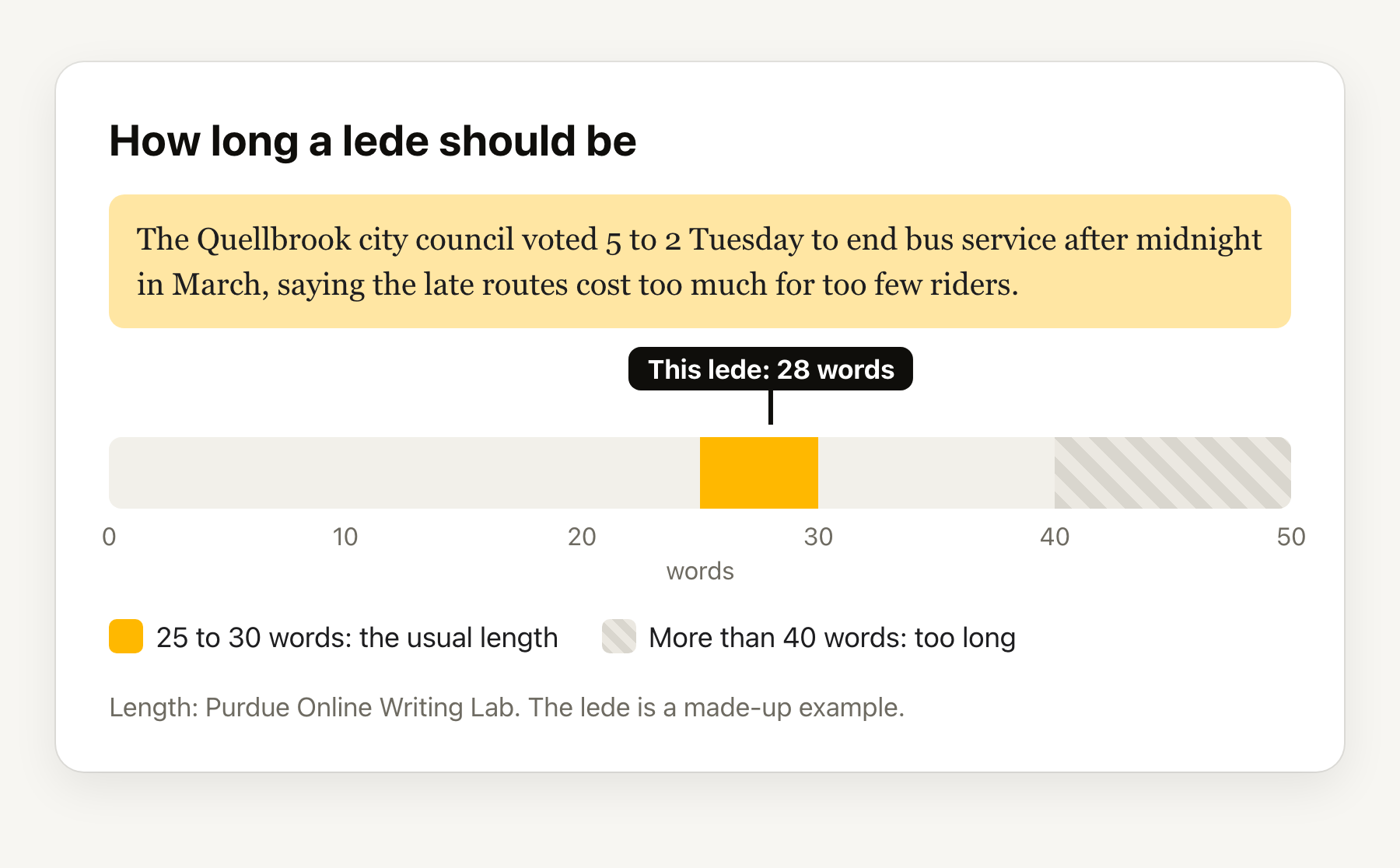
A lede should usually be 25 to 30 words, and under 40. It is often one sentence, sometimes two. This is the length the Purdue Online Writing Lab gives. Purdue says these numbers are a rough guide, not a rule.
If your lede runs past 40 words, you are probably trying to say too much at once. Move the second most important fact into the next sentence.
What are the types of leads in journalism?
The main types of lede are the summary lede, the anecdotal lede and the scene-setting lede. A summary lede says the news. The other two show a person or a place first.
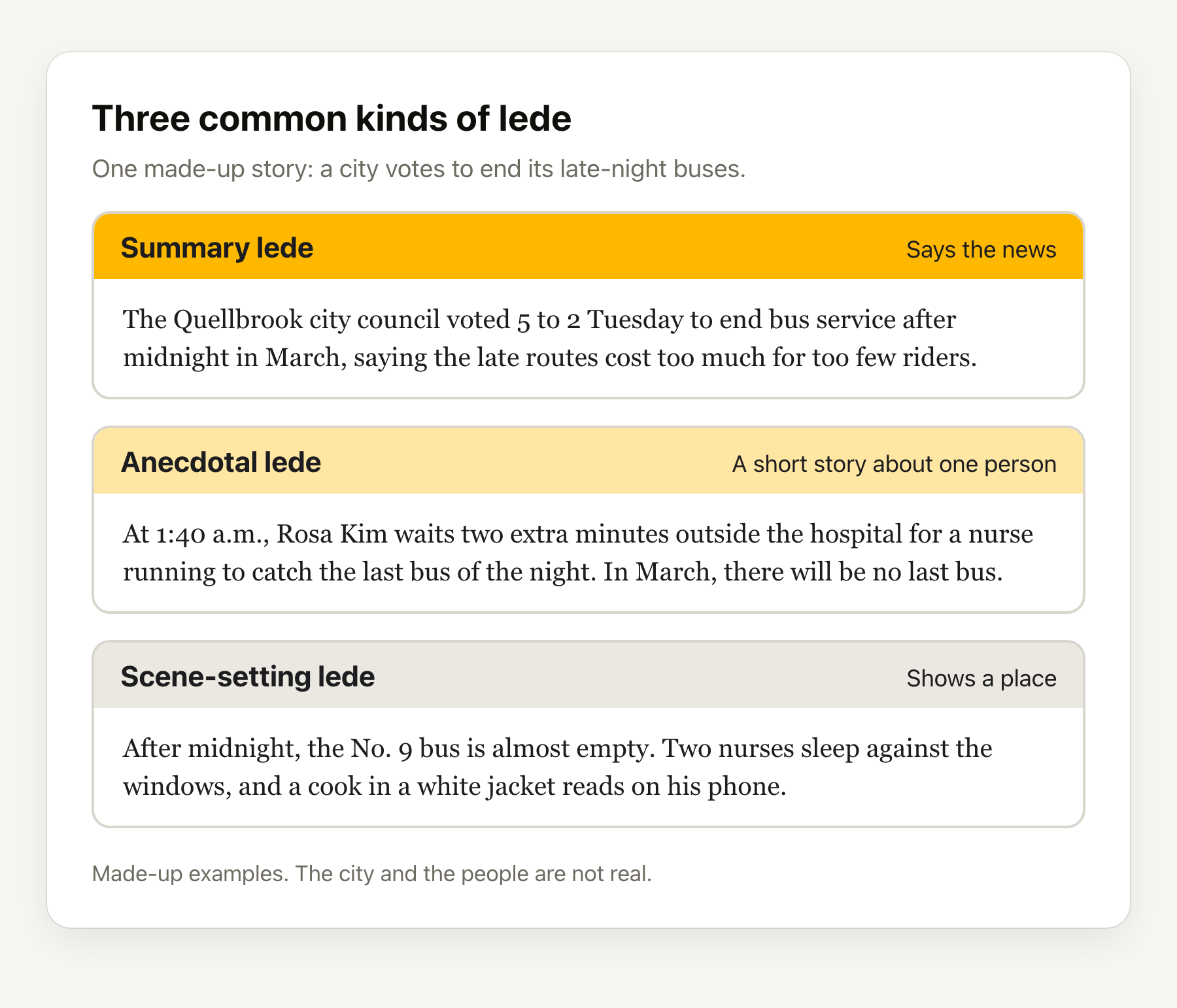
The examples in this guide are made up. They are all about the same story: a city that votes to end its late-night buses. The city and the people are not real.
The summary and the anecdotal lede have their own sections below. Here is the made-up scene-setting lede:
After midnight, the No. 9 bus is almost empty. Two nurses sleep against the windows, and a cook in a white jacket reads on his phone.
NPR's training guide adds three more, for six in all:
| Kind of lede | What NPR's guide says about it |
|---|---|
| Straight news (summary) | Just the facts, in one clear sentence. It works well for hard news and breaking news. |
| Anecdotal | A short story about one person that shows what the story is about. |
| Scene-setting | Draws the reader into a place. It needs thorough reporting. |
| First-person | Puts you, the writer, in the story. Use it rarely, only when your own experience is essential. |
| Observational | Steps back and says what the news means. It is useful a day or more after the news breaks. |
| Zinger | One short, surprising sentence that makes the reader stop. |
What is a summary lead?
A summary lede says the most important news in one sentence: who did what, and when. Purdue calls it perhaps the most traditional lede in news writing, and NPR's guide says it works well for hard news.
This made-up summary lede is 28 words long:
The Quellbrook city council voted 5 to 2 Tuesday to end bus service after midnight in March, saying the late routes cost too much for too few riders.
It answers who (the city council), what (end late-night buses), when (Tuesday, and March) and why (the cost). The details, like the number of riders and what they will do instead, go in the next paragraphs.
What is an anecdotal lead?
An anecdotal lede opens with a short story about one person, which shows what the whole story is about. It is common in features.
This made-up anecdotal lede opens with one person:
At 1:40 a.m., Rosa Kim waits two extra minutes outside the hospital for a nurse running to catch the last bus of the night. In March, there will be no last bus.
An anecdotal lede needs a paragraph soon after it that says the news plainly: the council's vote, and why it matters. In a feature, this paragraph is called the nut graf. Our guide on how to write a feature story explains it.
Can you start a lede with a question or a quote?
You can, but use them rarely. Purdue says to use question leads, quote leads and leads that speak to "you" sparingly and with care.
A question lede can catch the eye, but it doesn't tell the reader the news, so your second sentence has to do that work. A quote lede only works when the quote is better than anything you could write yourself.
What should you avoid in a lede?
Avoid anything that makes the reader work hard or that promises more than the story gives. NPR's and Purdue's guides list these:
- Cliches and bad puns.
- Long sentences that try to fit in every fact.
- Trying to sound clever. A lede that sounds smart but says little makes the reader stop.
- Saying someone "could never have imagined" what happened. Of course they couldn't. Tell the reader something concrete instead.
- The weather, unless the story is about the weather.
- Starting with "It". Most editors don't like it, because the reader doesn't yet know what "it" is.
- Too many adjectives and adverbs. Use strong nouns and verbs instead.
What does it mean to bury the lede?
To bury the lede means to put the most important fact too low in the story, where the reader may never reach it. The fix is to find that fact and move it to the first sentence.
The same rule applies to a pitch. Our guide on how to pitch an article to an editor shows how to put the most surprising fact first.
How do I write a lede faster?
You write a lede faster by planning the story before you write it. When you know what the story is, you know what goes in the first sentence.
Our guide on how journalists write so fast shows how to mark your notes while you report and write a five-line plan. The first line of that plan is the news, and it is a good start for your lede.
When should a journalist pay for a dictation app?
For simple, short text, like a text message, a web search or a quick reply, Apple Dictation works fine in most cases.
A paid app makes sense if you write for hours every day, and if you don't want to fix the dictation errors that Apple Dictation makes.
We've built Roar, the best way to write with your voice. Roar cleans up and formats text based on where you're writing to retain your exact meaning. Think of how emails, LinkedIn posts and AI prompts all need to be formatted differently. It keeps your exact words, to the best extent possible.
Roar keeps no recordings of your voice and no transcripts on our servers. It does not use your data to train AI models. Roar works on Macs with macOS 14 Sonoma or later and Apple silicon (M1 or newer).
With Roar, you can say three or four versions of your lede out loud, see them on the page, and keep the best one.
Your first 5 dictations on Roar are free. You can read how Roar works for journalists or download Roar for Mac.