How to write a feature story
A feature story starts with a person or a scene, then says why the story matters in a paragraph called the nut graf. This guide shows each part, with an example.
A feature story shows the people and the details behind the news. It usually starts with a person or a scene, says why the story matters a few paragraphs in, and ends by coming back to where it started.
We have built Roar, a dictation app that is light years ahead of Apple Dictation. There's a link to try Roar for free at the end of this article.
What makes a story a feature story?
A feature story goes deeper than a news story. It shows the people behind the news, with scenes, details and quotes that show how they feel.
A news story puts the news in its first sentence. A feature often starts with a person or a scene, and gives the news a few paragraphs later. An open textbook on media writing from Southern Illinois University notes that features almost always have more imagery and emotional quotes than straight news.
If you need the structure of a news story instead, read our guide on how journalists write so fast.
How do you structure a feature story?
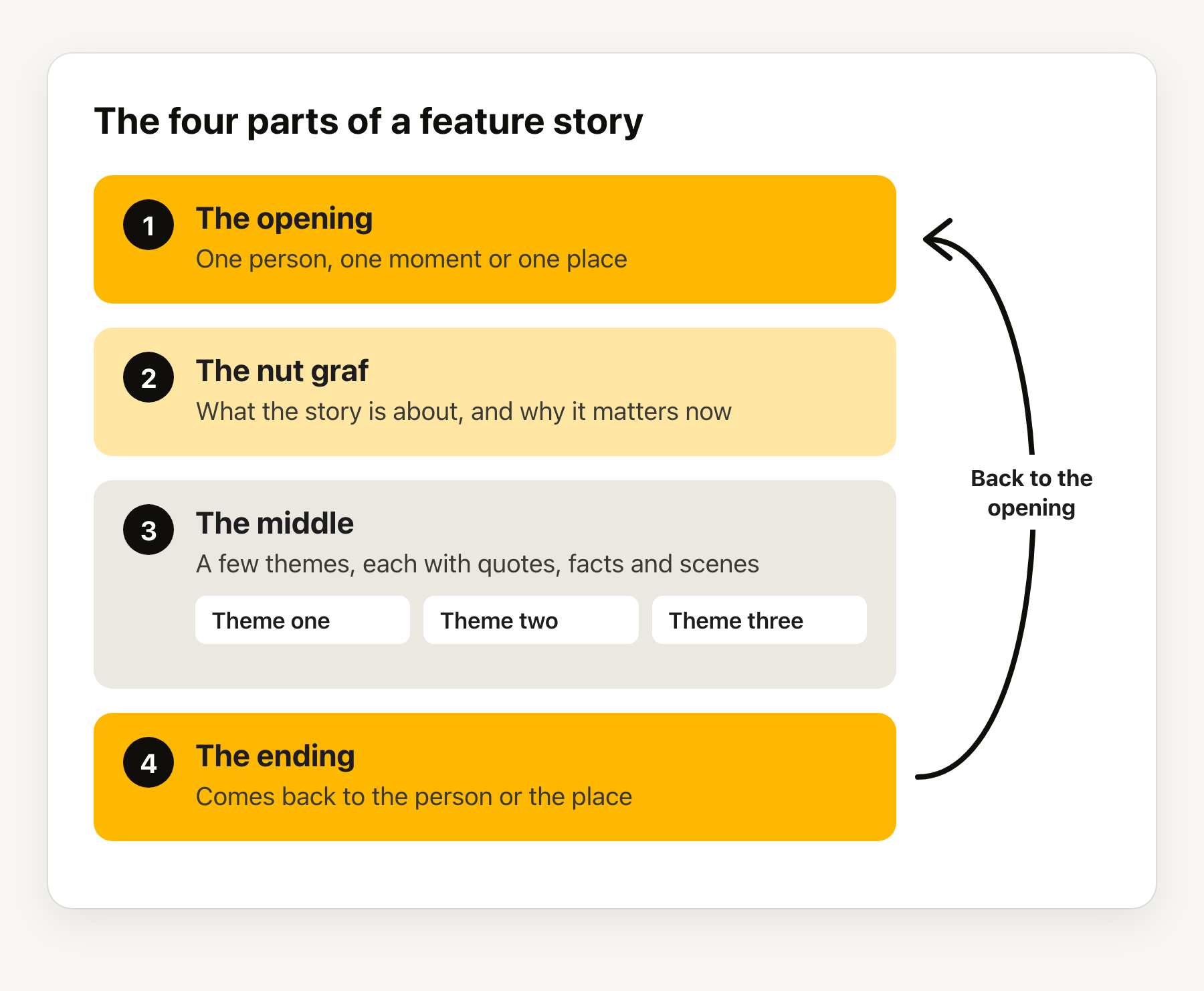
A feature story usually has four parts: an opening with a person or a scene, the nut graf, a middle made of a few themes, and an ending that comes back to the opening.
- The opening. One person, one moment or one place that shows what the story is about, in a few sentences.
- The nut graf. One paragraph that says what the story is about and why the reader should care now.
- The middle. A few parts, each about one theme. Each part has its own quotes, facts and scenes.
- The ending. It comes back to the person or the place from the opening, and leaves the reader with a sense that the story is finished.
The middle doesn't have to follow the order in which things happened. Bobby Hawthorne, a former director of the Interscholastic League Press Conference in Texas, says the story should follow a logical order, which "does not necessarily mean chronological order."
How do you start a feature story?
You start a feature story with something the reader can see or feel: a short scene, a moment in someone's day, a striking quote, or a startling fact. Hawthorne's guide for the University Interscholastic League lists five ways to open a feature.
The table shows each one, using the same made-up story. The story is about a city that plans to stop its late-night buses. The city, the driver and the riders are not real.
| The opening | A made-up example |
|---|---|
| A short story about one person | At 1:40 a.m., Rosa Kim stops the last bus of the night outside the hospital and waits two extra minutes. A nurse runs out, waving. Kim has never left her behind. |
| A scene | The bus is almost empty after midnight. Two nurses sleep against the windows, and a cook still in his white jacket reads on his phone. |
| A description of a person | Rosa Kim has driven the same night route for 11 years. She knows most of her riders by their first names. |
| A strong quote | "If this bus stops, I walk home for an hour in the dark," one of her riders says. |
| A startling fact | Four out of five people on the city's last bus are going to or from a night shift. |
Pick the one you can back with the best reporting. A scene only works if you were there, or if you can describe it from what people told you and checked.
What is a nut graf?
A nut graf is the paragraph that tells the reader what the whole story is about and why it matters. It comes right after the opening.
Chip Scanlan, who used to run the writing programs at the Poynter Institute, says the nut graf "tells the reader what the writer is up to." He lists four jobs it does:
- It tells readers why they should care.
- It links the opening to the rest of the story.
- It often says why the story matters now.
- It often adds a fact or two that shows why the story is important.
Most nut grafs are one paragraph long. Here is the nut graf of the made-up bus story:
The city plans to end all bus service after midnight in March to save money. For the people who ride those buses, many of them night-shift workers, there is often no other way home.
How do you write the middle of a feature story?
You write the middle of a feature in a few parts, each about one theme. In the bus story, the themes could be the riders, the money, and what riders will do if the buses stop.
- Choose a few themes. The Southern Illinois University textbook says to use only as many themes as you need to carry the reader to the end.
- Give each theme its own quotes, facts and scenes.
- Keep paragraphs short. The same textbook suggests one or two sentences each.
- Stay on the subject. Hawthorne says every part of the body should relate to the theme of the story.
Features are often built from long interviews. If you record them, our guide on how journalists transcribe interviews shows how to find the lines you need without typing out every word.
How do you end a feature story?
You end a feature story by coming back to the person or the place from the opening. The ending should feel finished, not just stop.
The Southern Illinois University textbook gives this advice for the ending:
- Don't summarize the story.
- Come back to the main person in the story.
- If the opening raised a problem, say what happened to it, or what could solve it.
The ending is often called the kicker. Many writers end on a quote, but the same textbook notes that great features usually don't end with a quote, though it isn't a hard rule.
Here is an ending for the made-up bus story:
At 5:10 a.m., Kim parks the bus at the depot. In March, she will drive days. "I'll still think about who's waiting at the hospital at 1:40," she says.
What is an example of a feature story?
Here is a made-up example: the outline of a feature about a city ending its late-night buses, from top to bottom.
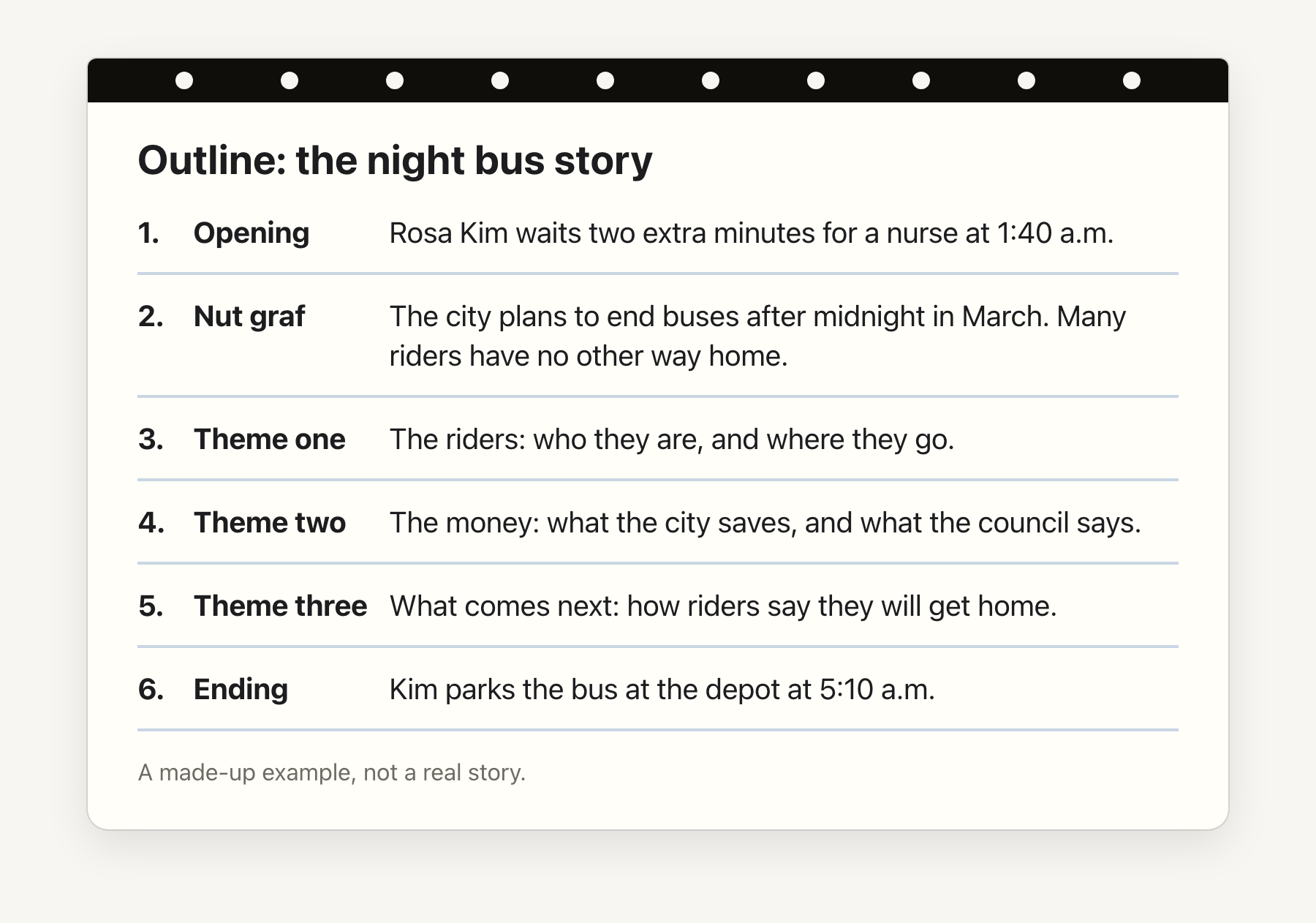
- Opening: Rosa Kim waits two extra minutes for a nurse at 1:40 a.m.
- Nut graf: the city plans to end buses after midnight in March, and many riders have no other way home.
- Theme one, the riders: who they are, and where they go.
- Theme two, the money: what the city saves, and what the city council says.
- Theme three, what comes next: how riders say they will get home.
- Ending: Kim parks the bus at the depot at 5:10 a.m.
Write a plan like this before you start the draft. When you know the order, the draft is much faster to write.
How long should a feature story be?
There is no fixed length for a feature story. The outlet decides, so ask your editor how many words they want before you start.
Whatever the length, every paragraph has to earn its place. The Southern Illinois University textbook puts it plainly: a feature should hold the reader's attention all the way through, or it needs an edit.
When should a journalist pay for a dictation app?
For simple, short text, like a text message, a web search or a quick reply, Apple Dictation works fine in most cases.
A paid app makes sense if you write for hours every day, and if you don't want to fix the dictation errors that Apple Dictation makes.
We've built Roar, the best way to write with your voice. Roar cleans up and formats text based on where you're writing to retain your exact meaning. Think of how emails, LinkedIn posts and AI prompts all need to be formatted differently. It keeps your exact words, to the best extent possible.
Roar keeps no recordings of your voice and no transcripts on our servers. It does not use your data to train AI models. Roar works on Macs with macOS 14 Sonoma or later and Apple silicon (M1 or newer).
With Roar, you can describe the opening scene out loud, the way you would tell a friend, and then shape it on the page.
Your first 5 dictations on Roar are free. You can read how Roar works for journalists or download Roar for Mac.