How to bill time in 6-minute increments
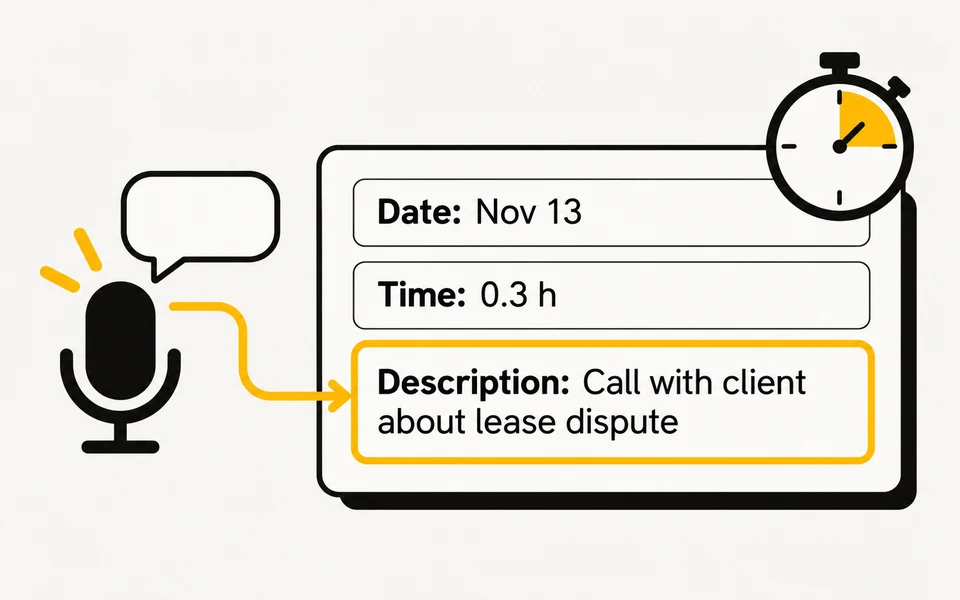
Lawyers often bill time in tenths of an hour. Each tenth is 6 minutes, so a 14-minute call is billed as 0.3 hours.
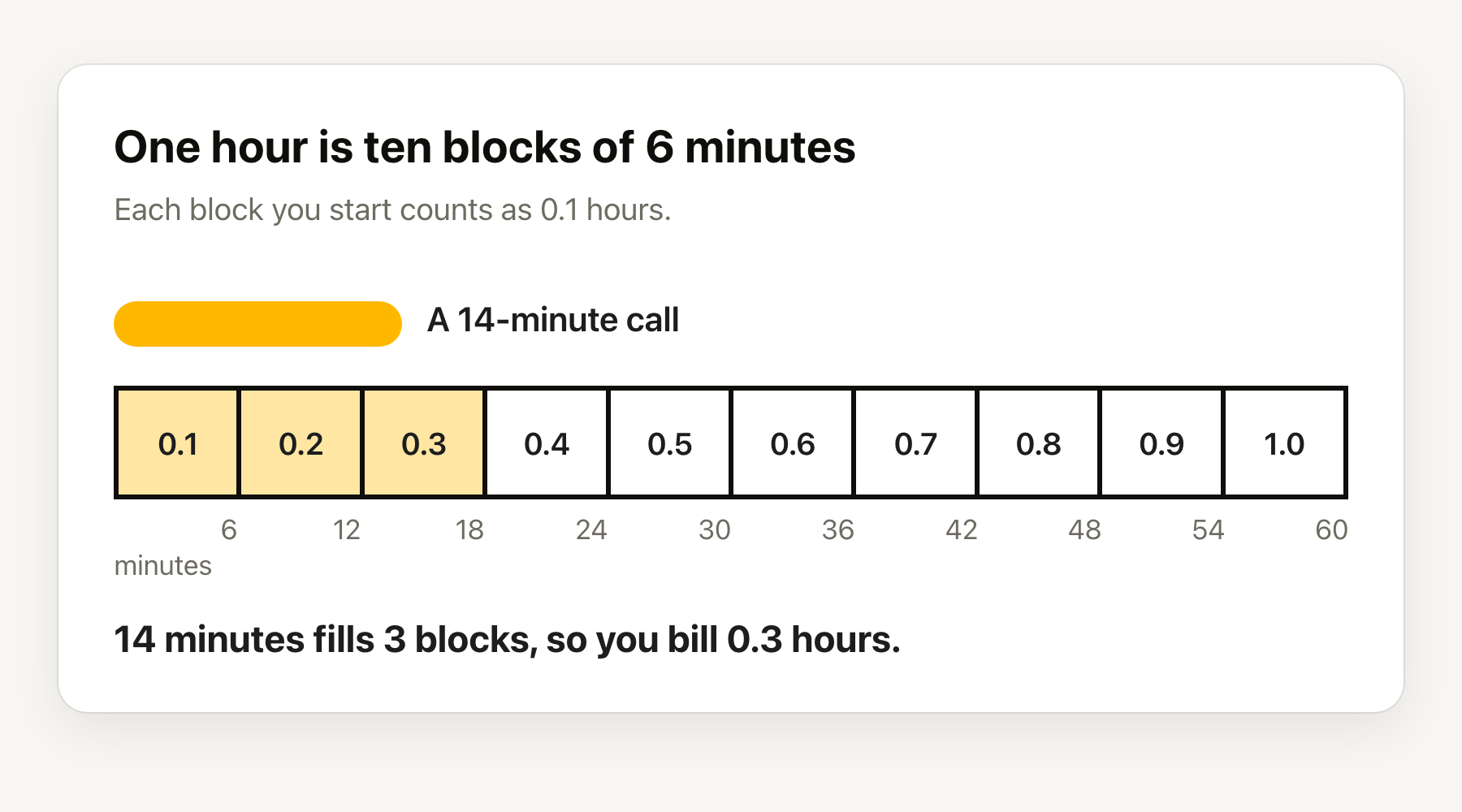
To bill in 6-minute increments, you count your time in tenths of an hour. One tenth of an hour is 6 minutes. Usually you round each task up to the next 6 minutes, so a task of 1 to 6 minutes is 0.1 hours, a task of 7 to 12 minutes is 0.2 hours, and so on.
We have built Roar, a dictation app that is light years ahead of Apple Dictation. There's a link to try Roar for free at the end of this article.
What does it mean to bill in 6-minute increments?
It means the smallest amount of time you record is 0.1 hours, which is 6 minutes. Every time entry is a multiple of 0.1, like 0.1, 0.4 or 1.3 hours.
The client sees the tenths on the invoice, multiplied by your hourly rate. If your rate is $300 an hour, 0.1 hours costs the client $30, and 0.3 hours costs $90.
Many courts and clients ask for time in tenths. The US Trustee Program's fee guidelines for large bankruptcy cases say time should be recorded in increments of no more than one tenth of an hour.
How do you calculate time in 6-minute increments?
Time needed Less than 1 minute per entry.
- Write down how many minutes the task took. Start counting when you start the work, and stop when you finish it.
- Divide the minutes by 6.
- If the answer is not a whole number, round it up to the next whole number.
- Write that number as tenths of an hour. 3 tenths is 0.3 hours. 13 tenths is 1.3 hours.
You can also use this chart. It is the chart the federal court for the Northern District of California gives to the lawyers it pays to defend people who can't afford a lawyer.
| Minutes worked | Hours to bill |
|---|---|
| 1 to 6 | 0.1 |
| 7 to 12 | 0.2 |
| 13 to 18 | 0.3 |
| 19 to 24 | 0.4 |
| 25 to 30 | 0.5 |
| 31 to 36 | 0.6 |
| 37 to 42 | 0.7 |
| 43 to 48 | 0.8 |
| 49 to 54 | 0.9 |
| 55 to 60 | 1.0 |
For more than an hour, count the full hours first, then use the chart for the minutes left over. A task of 1 hour and 20 minutes is 1.0 hours plus 0.4 hours, which is 1.4 hours.
How many minutes is 0.3 hours?
0.3 hours is 18 minutes. To turn tenths back into minutes, multiply by 60. So 0.1 hours is 6 minutes, 0.5 hours is 30 minutes, and 0.8 hours is 48 minutes.
If you round up, an entry of 0.3 hours means the task took between 13 and 18 minutes.
Why do lawyers bill in 6-minute increments?
Lawyers bill in tenths of an hour because decimals are easy to add up and multiply. The idea is usually credited to Reginald Heber Smith, a managing partner of the Boston law firm Hale and Dorr. In a memo from 1966, he wrote that he decided the smallest time entry should be one tenth of an hour, because the decimal system made the arithmetic easier.
Other firms and courts then did the same. Today many courts and clients ask for it in writing. The federal courts in Northern California and Arizona both ask the lawyers they pay to record time in tenths of an hour.
How do you bill in 15-minute increments?
In 15-minute increments, each block is a quarter of an hour, or 0.25 hours. A task of 1 to 15 minutes is billed as 0.25 hours, 16 to 30 minutes as 0.5 hours, and so on.
Quarter hours round up more than tenths. A 5-minute call is 0.1 hours in tenths, but 0.25 hours in quarters. That is two and a half times as much.
Some courts have cut fees because of this. In Welch v. Metropolitan Life, decided in 2007, the US Court of Appeals for the Ninth Circuit upheld a 20% cut in a lawyer's fees. The lower court found that billing by the quarter hour had led to a request for too many hours. The Sixth Circuit's guide for appointed lawyers says time reported in quarter hours may be rounded down.
Not every court agrees. In 2018, the Wyoming Supreme Court found that a law firm's 15-minute minimum was not unreasonable in the case in front of it.
So if you bill in quarter hours, make sure your engagement letter says so, and make sure your court or client accepts it.
Can a lawyer bill 0.1 for a short email?
Yes, if the email took up to 6 minutes and your agreement with the client bills in tenths. In a 6-minute system, 0.1 is the smallest entry you can record.
But be careful when there are many of them. Oakland County, Michigan, pays lawyers to defend people who can't afford one. Its fee plan counts a letter or text message to a client as 0.1 hours. When there are a lot of those in one case, the plan cuts each one to half of that, which is 3 minutes.
The US Trustee Program's guidelines allow small tasks to be grouped together in one entry, if they add up to no more than 0.5 hours in a day. For example, five short emails that took 15 minutes in total can be one entry of 0.3 hours.
Can you bill two clients for the same 6 minutes?
No. You can only bill the time you actually spent. The American Bar Association's Formal Opinion 93-379, as quoted by the North Carolina State Bar, says that a lawyer who spends four hours on behalf of three clients has not earned twelve billable hours.
The North Carolina State Bar says the same in its 2022 Formal Ethics Opinion 4. It says billing more than the time you actually spent is dishonest and misleading.
So if one 6-minute phone call covers two matters, split it between the two clients, or bill it to one of them. Don't bill 0.1 to both.
How do lawyers keep track of 6-minute increments?
The simplest way is to write each time entry as soon as the task ends, while you still know how long it took. The US Trustee Program's guidelines ask for time to be recorded at the time the work is done.
- When a task ends, open the time entry for that matter.
- Write the minutes, then convert them to tenths with the chart above.
- Write one or two sentences that say what you did and why.
- Save it before you start the next task.
Many lawyers track time in practice management software, such as Clio. If you write the entries yourself, our guide with examples of billing narrative for lawyers shows what to write in the description. For the bigger picture, like how many billable hours law firms expect, read our billable hours guide for lawyers.
You can also say the description instead of typing it. Apple Dictation is free on every Mac. Our guide on how to dictate on a Mac shows how to turn it on.
When should a lawyer pay for a dictation app?
For simple, short text, like a text message, a web search or a quick reply, Apple Dictation works fine in most cases.
A paid app makes sense if you write for hours every day, and if you don't want to fix the dictation errors that Apple Dictation makes.
We've built Roar, the best way to write with your voice. Roar cleans up and formats text based on where you're writing to retain your exact meaning. Think of how emails, LinkedIn posts and AI prompts all need to be formatted differently. It keeps your exact words, to the best extent possible. Roar types into Clio, Microsoft Word, Microsoft Outlook and Gmail, so you can say a time entry or an email as soon as a call ends.
Roar keeps no recordings of your voice and no transcripts on our servers. It does not use your data to train AI models. Roar works on Macs with macOS 14 Sonoma or later and Apple silicon (M1 or newer).
Your first 5 dictations on Roar are free. You can read how Roar works for lawyers or download Roar for Mac.