Billable hours guide for lawyers: how to count them and how most lawyers do it
What billable hours are, what counts as billable, how many hours law firms expect, and why most lawyers are missing out on billable hours.
Billable hours are the hours a lawyer works on a client's matter that the client pays for. Lawyers usually record them in tenths of an hour, which is 6 minutes, and charge them at an hourly rate on the invoice.
We have built Roar, a dictation app that is light years ahead of Apple Dictation. There's a link to try Roar for free at the end of this article.
What are billable hours?
Billable hours are the time you record against a client's matter so you can charge that client for it.
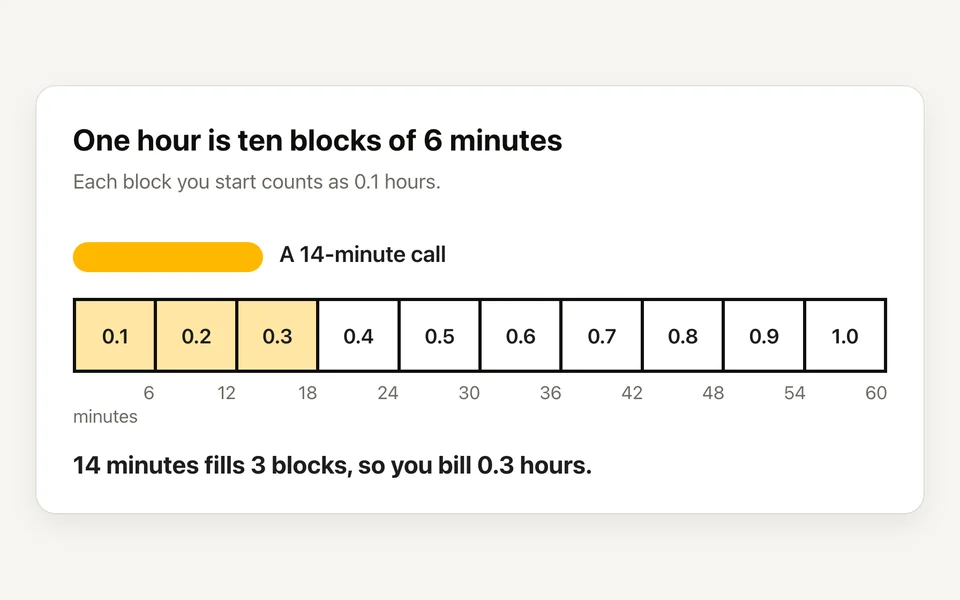
Most lawyers record time in tenths of an hour. One tenth is 6 minutes. So a 15-minute call goes on the record as 0.3 hours, and the client sees 0.3 times your hourly rate.
The fee itself is agreed with each client. Under the American Bar Association's Model Rule 1.5, a lawyer must tell the client the basis or rate of the fee, preferably in writing, before or soon after the work starts. The same rule says a fee must not be unreasonable.
How do you convert minutes to billable hours?
Round the minutes up to the next block of 6 minutes, and count each block as 0.1 hours.
| Minutes worked | Billable hours |
|---|---|
| 1 to 6 | 0.1 |
| 7 to 12 | 0.2 |
| 13 to 18 | 0.3 |
| 19 to 24 | 0.4 |
| 25 to 30 | 0.5 |
| 31 to 36 | 0.6 |
| 37 to 42 | 0.7 |
| 43 to 48 | 0.8 |
| 49 to 54 | 0.9 |
| 55 to 60 | 1.0 |
This is the chart the federal court for the Northern District of California gives to appointed lawyers. Your firm or your client may use a different rule, so check your engagement letter.
What counts as billable hours for lawyers?
Work you do directly on a client's matter usually counts as billable. Work you do for the firm usually does not.
Billable work includes:
- Calls and meetings about the matter, with the client, the other side, witnesses or experts
- Legal research for the matter
- Drafting and editing letters, contracts, motions and memos
- Reading documents, discovery and the other side's changes
- Emails about the matter
- Hearings, depositions and negotiations
Non-billable work includes:
- Lunch and breaks
- Reading general legal news and general mail
- Firm meetings, conferences and continuing legal education (CLE)
- Marketing and pitching for new clients
- Office work, including preparing the bills
How many billable hours do lawyers work?
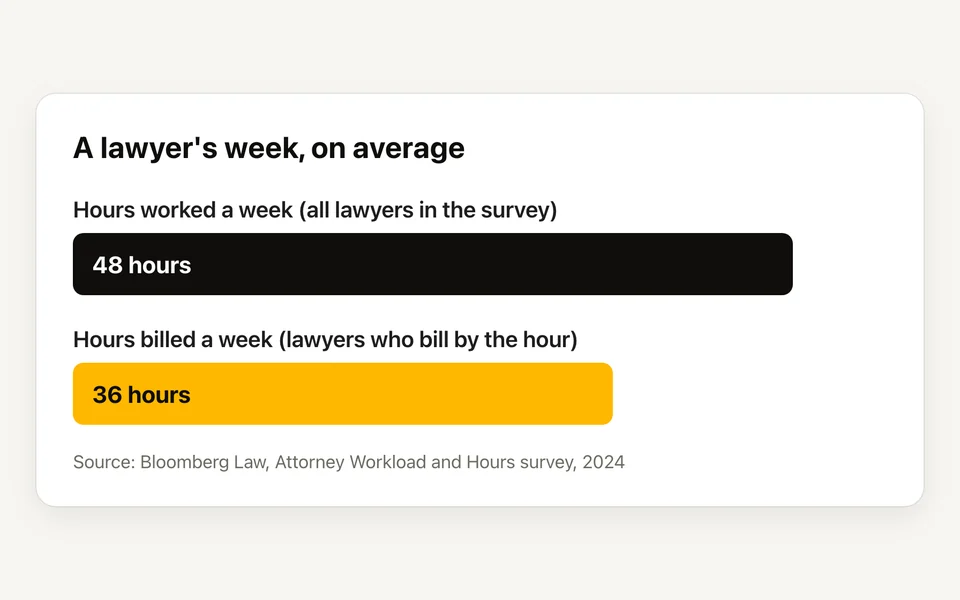
Law firms usually ask for 1,700 to 2,300 billable hours a year, according to Yale Law School's career office. But the average lawyer records about 3 billable hours in an 8-hour day.
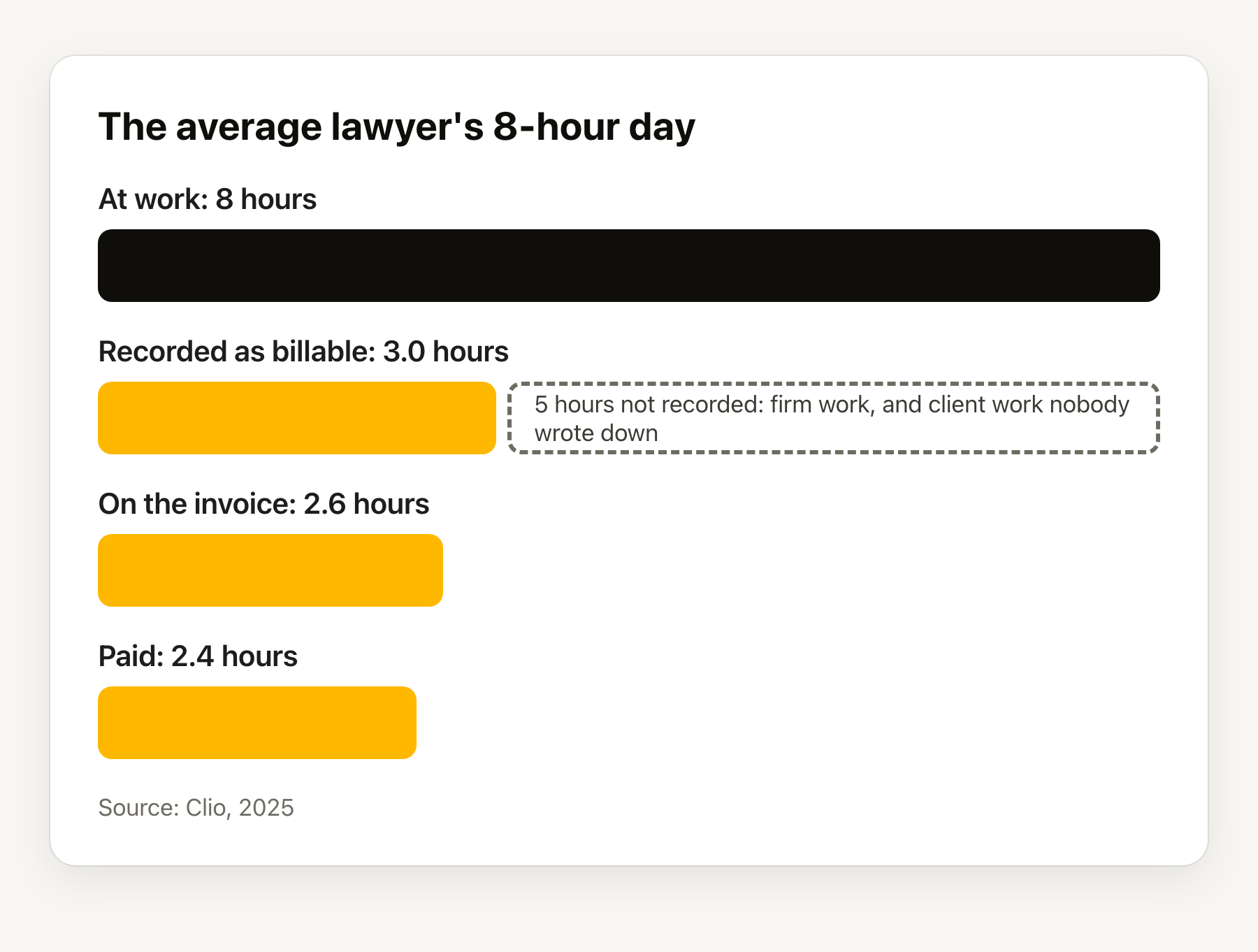
Clio, which makes software that law firms use to track time, publishes yearly numbers from its users. Its 2025 numbers for an average 8-hour day are:
- 3.0 hours recorded as billable work (Clio calls this utilization, 38%)
- 2.6 of those hours put on an invoice (realization, 88%)
- 2.4 of those hours paid by the client (collection, 93%)
These two numbers come from different groups of lawyers. Yale notes that smaller firms, and firms outside large cities, often ask for fewer hours. Clio's average includes small firms and solo lawyers, who also do their own marketing, billing and office work.
Is 2000 billable hours a lot?
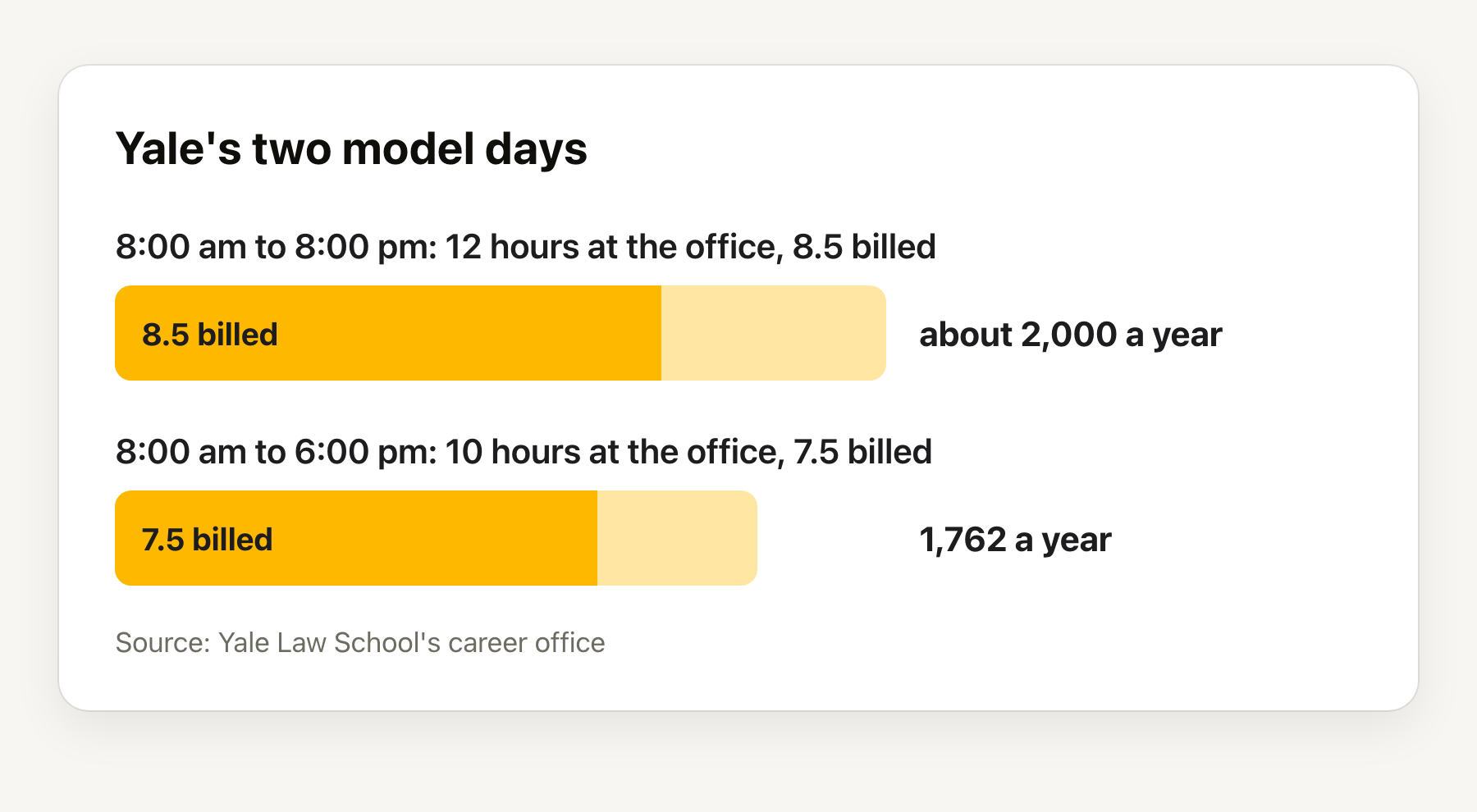
Yes. Yale Law School's career office shows that billing about 2,000 hours a year takes a 12-hour day at the office, five days a week.
Yale's example works like this:
- You are at the office from 8:00 am to 8:00 pm, which is 12 hours.
- Lunch, dinner, breaks, meetings and training take 3.5 hours.
- That leaves 8.5 billable hours a day, or 42.5 a week.
- Take off 3 weeks of vacation and 2 weeks of holidays. That leaves 47 weeks.
- 42.5 hours times 47 weeks is 1,997 billable hours.
So 2,000 billable hours means about 60 hours a week at the office, with no sick days.
Yale also shows a shorter day. At the office from 8:00 am to 6:00 pm, you bill 7.5 hours a day, which is 1,762 hours a year.
What is the difference between billable hours and hours worked?
Hours worked is all the time you spend at work. Billable hours are only the part you record against a client. And only part of that reaches the invoice.
Here is the average lawyer's 8-hour day, from Clio's 2025 numbers:
Some of the 5 hours that are not recorded are firm work, like office work and marketing. That time should not be billed. But some of it can be client work that nobody wrote down, like a short call or a quick email. Clio's numbers don't show how much of the 5 hours is firm work and how much is client work.
Client work that is not written down is lost. This often happens when you wait to record your time. Clio's own advice is to track your time as you go, because hours are forgotten when you track them at the end of the day. A time entry you write as soon as a call ends has the right length and the right details. An entry you write days later is often a guess, and short calls are the easiest to forget.
How do lawyers track billable hours?
Lawyers track billable hours with a timer that runs while they work, or by writing a time entry as soon as each task ends. Many use practice management software, such as Clio.
- When a task ends, open the time entry for that matter.
- Write how long it took, in tenths of an hour.
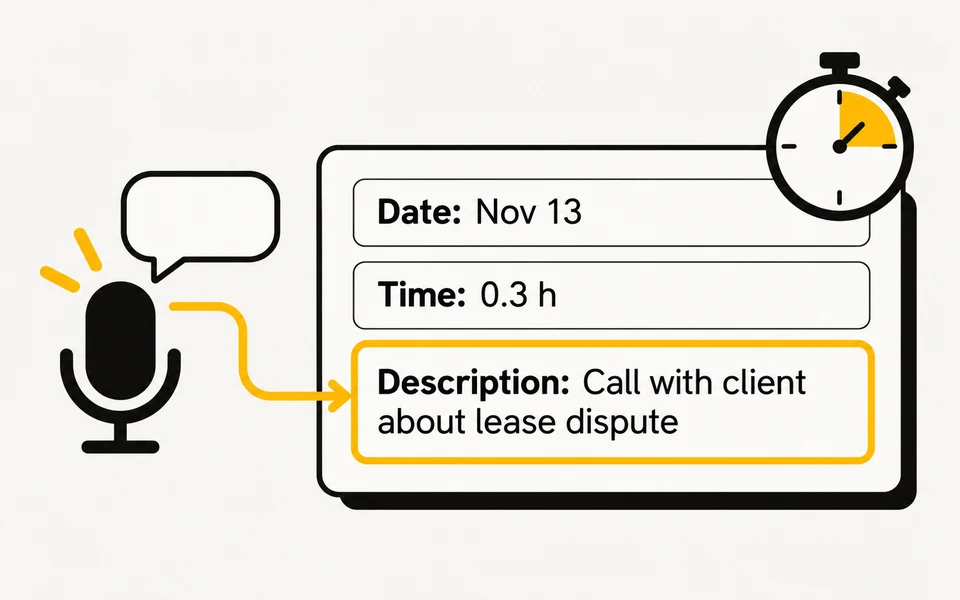
- Write what you did and why, in one or two clear sentences.
- Save it before you start the next task.
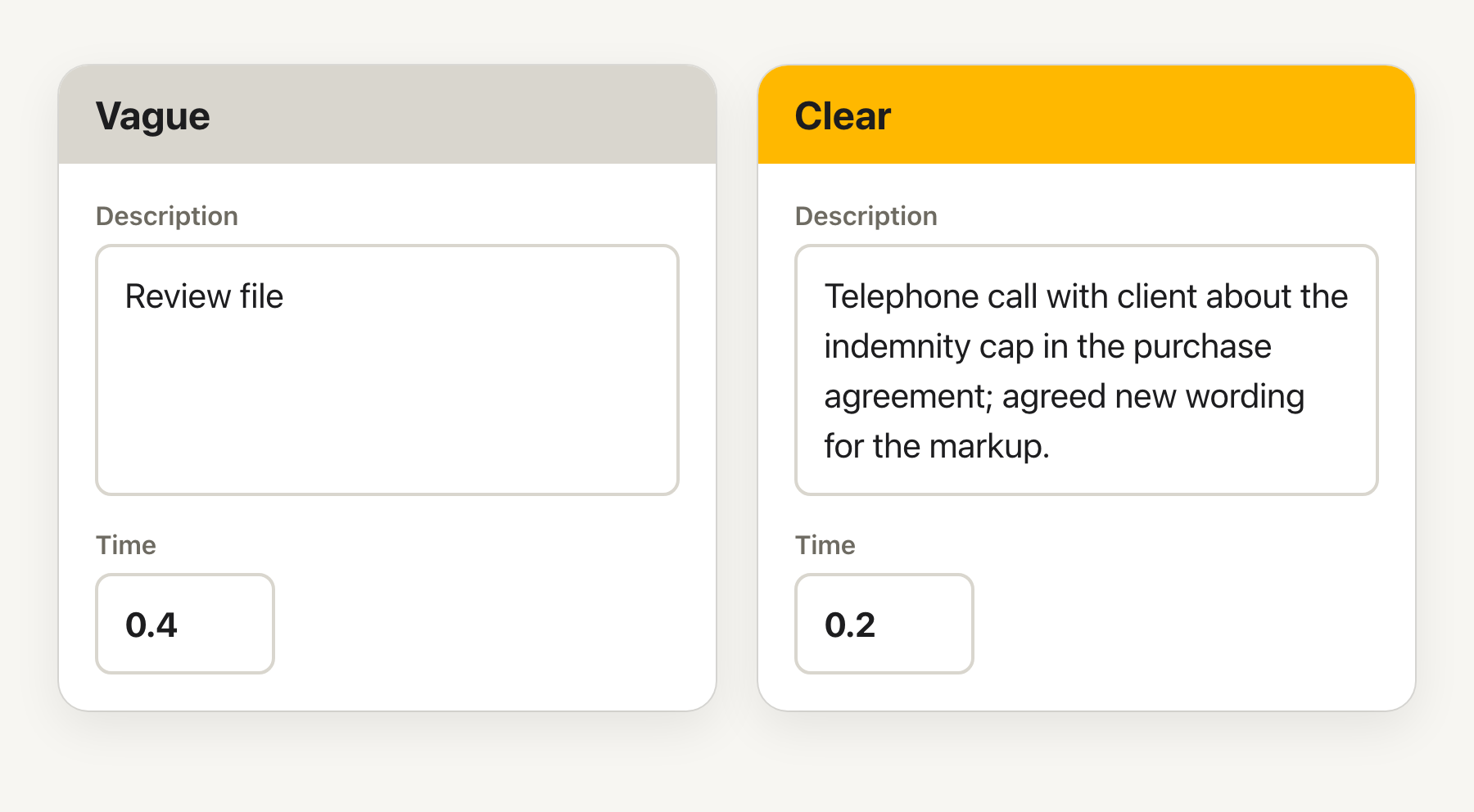
Write the description so the client understands it. The US Trustee Program's fee guidelines say that time should be recorded at the time of the work, in tenths of an hour, and that phrases like "review file" or "attention to" are usually not enough on their own.
If typing the description is the part you put off, try saying it. Apple Dictation is free on every Mac. Our guide on how to dictate on a Mac shows how to turn it on.
Can lawyers bill for the time they save with AI or dictation?
No. If you bill by the hour, you can only bill the time you actually spent. The American Bar Association's Formal Opinion 512, on lawyers using AI tools, says lawyers who bill by the hour must bill for their actual time.
So a tool that makes you faster does not add billable hours. It gives you time back for other work. The only billable time it can help with is work you already did and would otherwise forget to record.
When should a lawyer pay for a dictation app?
For simple, short text, like a text message, a web search or a quick reply, Apple Dictation works fine in most cases.
A paid app makes sense if you write for hours every day, and if you don't want to fix the dictation errors that Apple Dictation makes.
We've built Roar, the best way to write with your voice. Roar cleans up and formats text based on where you're writing to retain your exact meaning. Think of how emails, LinkedIn posts and AI prompts all need to be formatted differently. It keeps your exact words, to the best extent possible. Roar types into Clio, Microsoft Word, Microsoft Outlook and Gmail, so you can say a time entry or an email as soon as a call ends.
Roar keeps no recordings of your voice and no transcripts on our servers. It does not use your data to train AI models. Roar works on Macs with macOS 14 Sonoma or later and Apple silicon (M1 or newer).
Your first 5 dictations on Roar are free. You can read how Roar works for lawyers or download Roar for Mac.