How to write a demand letter for personal injury
A personal injury demand letter tells the insurer what happened, why its insured is at fault, what your client lost and what it will take to settle. Here is a template.

A personal injury demand letter is a letter to the at-fault person's insurer that asks for a sum of money to settle the claim. It is usually sent before a lawsuit is filed.
We have built Roar, a dictation app that is light years ahead of Apple Dictation. There's a link to try Roar for free at the end of this article.
What is a personal injury demand letter?
A personal injury demand letter is the injured person's first written offer to settle. It sets out the facts, the injuries and the losses, and names the amount the person will accept.
The insurer's adjuster uses it to value the claim. A clear letter with the records attached gives the adjuster less reason to ask for more time.
What should a personal injury demand letter include?
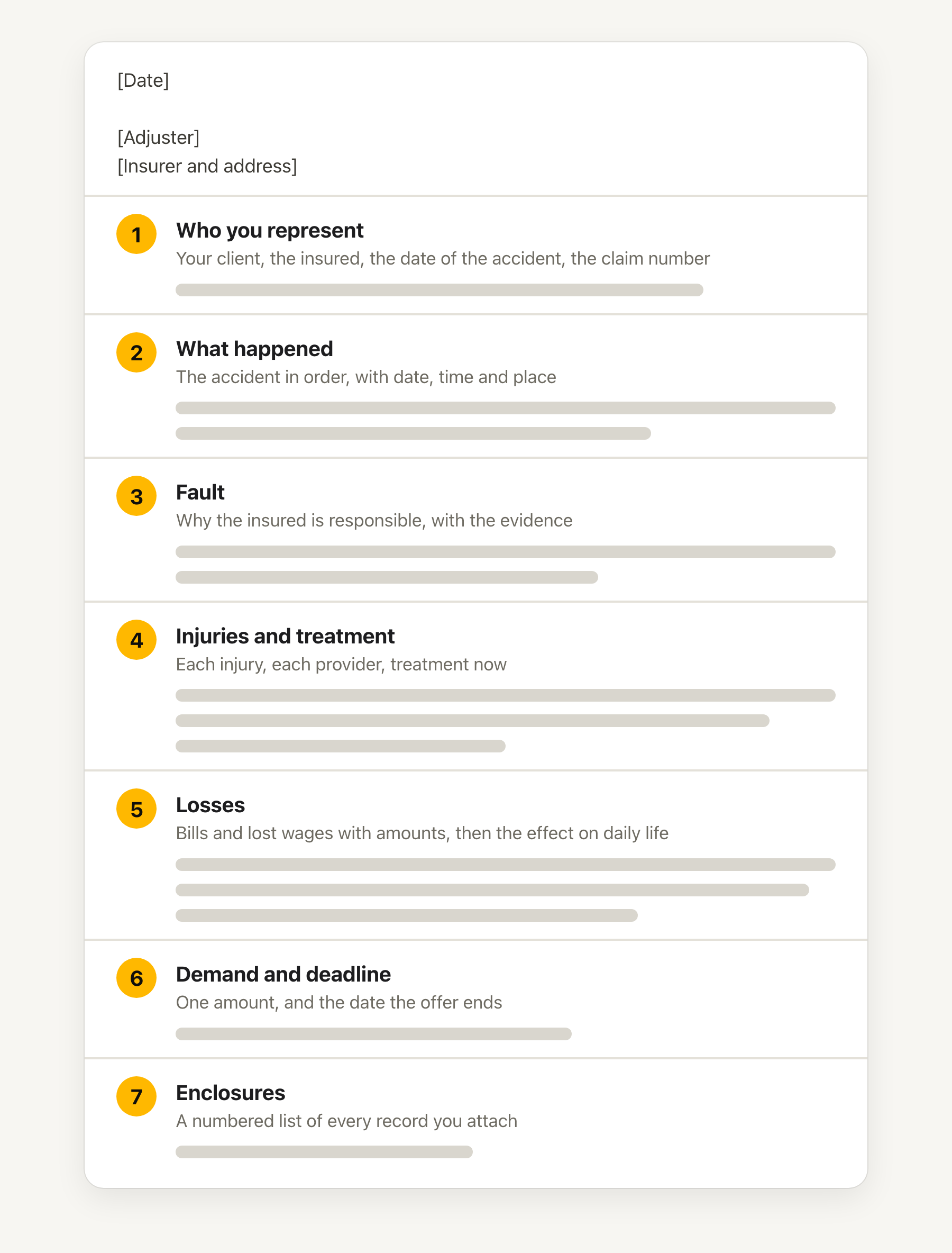
A personal injury demand letter should include the facts, the evidence of fault, the injuries, every loss with its amount, a clear demand and a deadline. TexasLawHelp.org, run by Texas Legal Services Center, gives a similar list for any demand letter: the facts with dates, the evidence, a clear demand, a deadline, and what you will do if the demand is not met.
| Part | What goes in it |
|---|---|
| 1. Who you represent | Your client, the insured, the date of the accident and the claim number |
| 2. What happened | The accident in the order it happened, with the date, time and place |
| 3. Fault | Why the insured is responsible, with the evidence: the police report, photos, witnesses |
| 4. Injuries and treatment | Each injury, each provider, and where your client is in treatment now |
| 5. Losses | Medical bills and lost wages, item by item with amounts, then the pain and the limits on daily life |
| 6. Demand and deadline | One amount to settle the claim, and the date the offer ends |
| 7. Enclosures | A numbered list of every record you attach |
What does a personal injury demand letter template look like?
Here is a template you can copy into your letterhead. Replace everything in square brackets.
[Date]
[Adjuster's name]
[Insurer's name and address]
Re: Your insured: [name]; Our client: [name]; Claim number: [number]; Date of loss: [date]
Dear [Adjuster's name]:
This firm represents [client] for injuries from the [type of accident] on [date] involving your insured, [name]. Please direct all communication about this claim to me.
What happened
[What happened, in order, with the date, time and place. Short, plain sentences.]
Fault
[Why your insured is responsible. Point to the evidence: the police report, photos, witness statements, any citation. Refer to each one by its enclosure number.]
Injuries and treatment
[Each injury. Each provider, with the dates of treatment. Whether treatment is finished, and what the doctor expects next.]
Losses
[Itemized table of medical bills, by provider, with a total.]
[Lost wages: the days missed, the gross pay for each day, and the total.]
[How the injuries changed your client's daily life: work, sleep, family, the things they could not do. Use specific examples from your client and the records.]
Demand
To settle all claims arising from this accident, [client] demands $[amount]. This offer remains open until [date]. Please send your response to me in writing.
Sincerely,
[Your name]
Enclosures: [numbered list of every record attached]
What is a good example of a demand letter for a car accident?
Here is a filled-in example of the main parts. The people, the accident and the amounts are made up. The insurer and the adjuster are left as gaps.
Re: Your insured: Daniel Price; Our client: Teresa Molina; Claim number: [number]; Date of loss: March 3, 2026
What happened
On March 3, 2026, at about 5:40 p.m., Ms. Molina was stopped at a red light on Elm Street at 4th Avenue. Your insured, Mr. Price, drove into the back of her car. The impact pushed her car into the crosswalk.
Fault
The police report (Enclosure 1) says Mr. Price told the officer he looked down at his phone. The officer cited him for following too closely. A witness at the corner confirms Ms. Molina's car was stopped (Enclosure 2).
Injuries and treatment
Ms. Molina went to the emergency room that evening with neck and back pain. An MRI on March 10 showed a herniated disc in her neck. She saw an orthopedic doctor three times and finished 18 sessions of physical therapy on June 26. Her doctor expects some neck stiffness to continue (Enclosure 3).
| Loss | Amount |
|---|---|
| Emergency room, March 3 | $3,850 |
| MRI, March 10 | $1,600 |
| Orthopedic doctor, three visits | $1,240 |
| Physical therapy, 18 sessions | $2,880 |
| Prescriptions | $180 |
| Medical bills, total | $9,750 |
| Lost wages, 12 workdays at $210 a day, before taxes | $2,520 |
| Total medical bills and lost wages | $12,270 |
Ms. Molina is a dental hygienist. For six weeks she could not lean over patients, and she missed 12 days of work. She could not lift her two-year-old son for a month. She still wakes up with neck pain most mornings.
Demand
To settle all claims arising from this accident, Ms. Molina demands $48,000. This offer remains open until [date]. Please send your response to me in writing.
How do you put pain and suffering in a demand letter?
Describe how the injuries changed your client's daily life, with specific examples, and back each one with the records. There is no fixed formula in the letter for the amount. It is part of the one demand figure you and your client agree on.
Specific beats general. "She suffered great pain" tells the adjuster nothing. "She could not lift her two-year-old son for a month" gives the adjuster a fact to weigh.
Good sources for these details are your client's own words, the doctor's notes on pain and limits, and the physical therapy records.
Do you have to pay back medical bills from a personal injury settlement?
Often, yes. Before you name an amount, find out who has a claim on the settlement money, because the settlement may have to repay them.
- Medicare: if Medicare paid your client's bills, the Centers for Medicare & Medicaid Services (CMS) recovers those payments from liability settlements.
- Medicaid, a health insurer or a hospital may also have a claim, depending on the plan and your state's law.
Ask your client who paid each bill, and ask each payer for the amount it claims. Your demand should leave room for these repayments.
What not to say in a demand letter?
Don't say anything you can't prove, and don't make threats. TexasLawHelp.org warns never to threaten the other side with illegal activity or harm.
Avoid these as well:
- An amount your client has not agreed to. Under the American Bar Association's Model Rule 1.2, the client decides whether to settle.
- A guess about future bills. If treatment is not finished, say so, and say what the doctor expects.
- Anything that suggests your client was partly at fault, unless you have decided to deal with it head on.
- Numbers that don't match the bills. The adjuster will add them up.
How long should the deadline in a demand letter be?
Give the insurer enough time to review the records, and check your state's law first. TexasLawHelp.org suggests at least seven business days for an ordinary demand letter. In a personal injury claim, the adjuster also has to read the medical records, so give more time than that.
Before you set a deadline, ask the insurer for its insured's policy limits. Some states have laws on demands that offer to settle within the policy limits by a deadline. Georgia, for example, changed its law on time-limited demands in car accident cases in 2024 (O.C.G.A. § 9-11-67.1), as the Mercer Law Review's 2024 survey of insurance law describes. A demand that misses a term the law requires may not do what you meant it to.
Can I write my own demand letter?
Yes. Anyone can send a demand letter, and you don't need a lawyer to do it. TexasLawHelp.org notes that a letter from a lawyer may be taken more seriously. A letter does not stop the deadline for filing a lawsuit either, as the deadline section above explains.
This template is written for lawyers and paralegals. If you were hurt and have no lawyer, read your state's legal aid pages before you send a letter to an insurer.
How do you write a demand letter faster?
Say the story parts out loud, and type the numbers. The facts, the injuries and the effect on your client's life are the longest parts of the letter, and they are the easiest to say.
Your Mac has free dictation built in, called Apple Dictation.
- Open your template in Microsoft Word or Google Docs, and click under "What happened".
- Press the Microphone key once. On most Mac keyboards from the last few years, the F5 key has a small microphone on it. This is the Microphone key. If Siri is turned on, holding the key opens Siri instead.
- Say the paragraph, then press the Microphone key again.
- Type the amounts, dates and claim number with the keyboard, and check each against the records.
Apple Dictation stops by itself after 30 seconds of silence. Apple designed it this way. If you stop to read a record, press the Microphone key again before you carry on.
When your client agrees on the demand amount, record it. Our memo to file template has an example of a memo about a client's settlement decision. If Dictation is not turned on yet, our guide on how to dictate on a Mac shows how.
When should a lawyer pay for a dictation app?
For simple, short text, like a text message, a web search or a quick reply, Apple Dictation works fine in most cases.
A paid app makes sense if you write for hours every day, and if you don't want to fix the dictation errors that Apple Dictation makes.
We've built Roar, the best way to write with your voice. Roar cleans up and formats text based on where you're writing to retain your exact meaning. Think of how emails, LinkedIn posts and AI prompts all need to be formatted differently. It keeps your exact words, to the best extent possible.
Roar works in the apps lawyers use every day, like Microsoft Word, Microsoft Outlook, Gmail and Clio.
Roar keeps no recordings of your voice and no transcripts on our servers. It does not use your data to train AI models. Roar works on Macs with macOS 14 Sonoma or later and Apple silicon (M1 or newer).
Your first 5 dictations on Roar are free. You can read how Roar works for lawyers or download Roar for Mac.