Legal memo format and template with an example memo
A legal memo has six parts, from the heading to the conclusion. This is a free legal memo template with a plain note on each part and a filled-in example.
A legal memo, also called an office memorandum, answers one legal question for another lawyer. It says how a court is likely to decide, and why.
We have built Roar, a dictation app that is light years ahead of Apple Dictation. There's a link to try Roar for free at the end of this article.
What is the format of a legal memo?
A legal memo has six parts: a heading, the question presented, a brief answer, the facts, the discussion and a conclusion. This is the format the legal writing centers at CUNY School of Law and Columbia Law School teach.
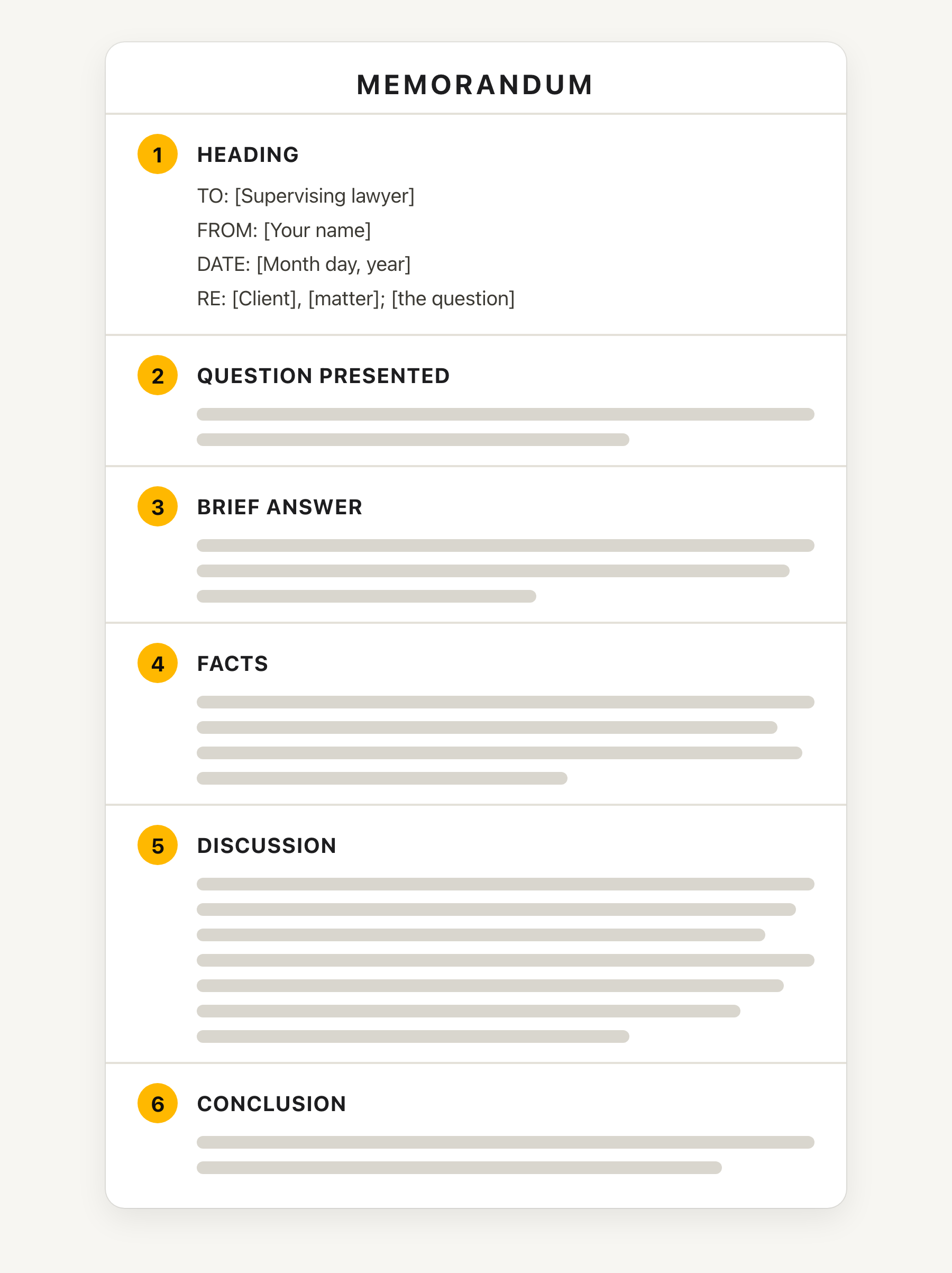
| Part | What goes in it |
|---|---|
| 1. Heading | The word MEMORANDUM, then To, From, Date and Re. The Re line names the client and the subject. |
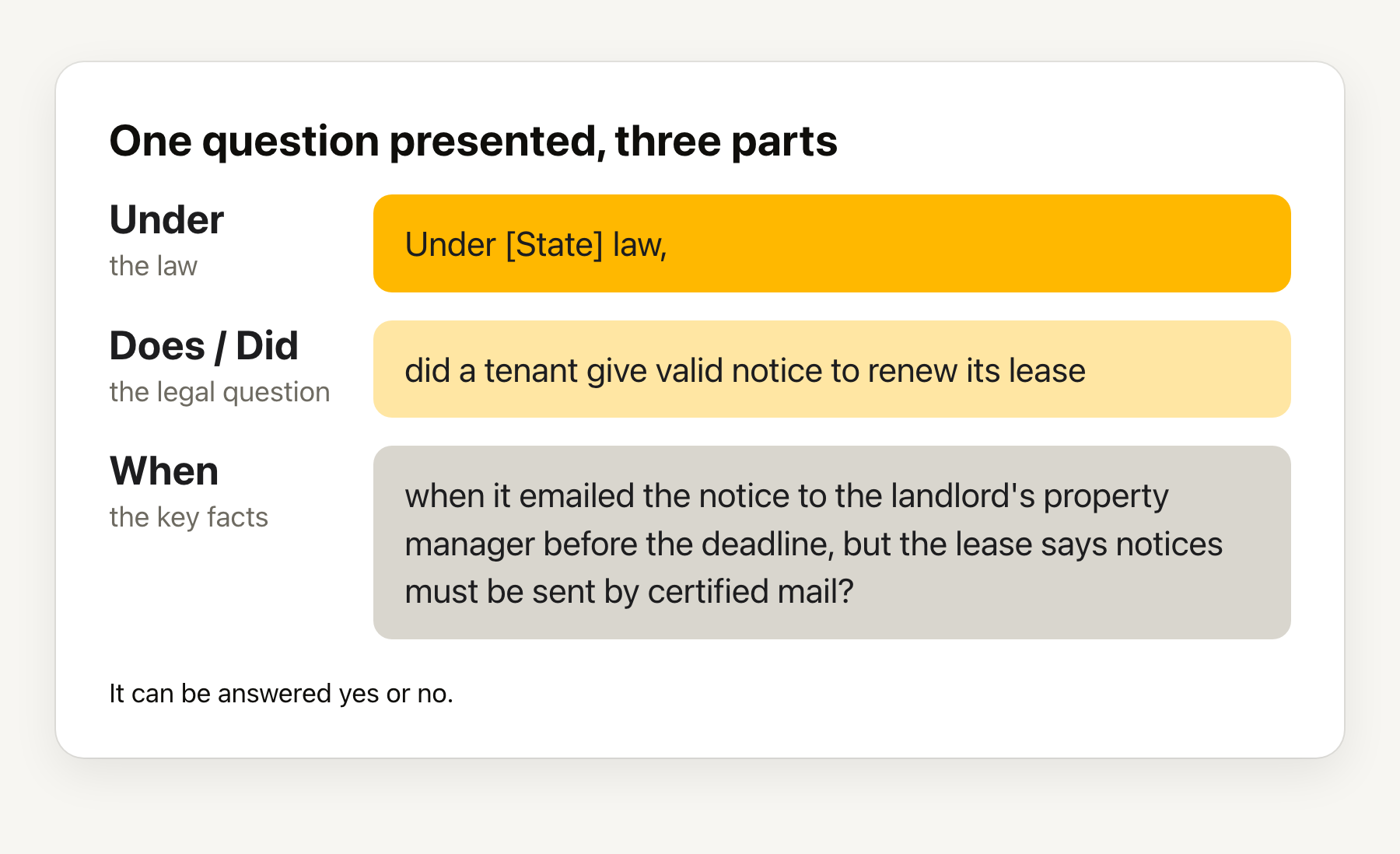
| 2. Question presented | The legal question in one sentence, with the law, the issue and the key facts. It can be answered yes or no. |
| 3. Brief answer | Yes, no or probably, then the reason in a few sentences. Usually no citations. |
| 4. Facts | The facts that matter to the law, told in order and without your opinion of them. |
| 5. Discussion | The analysis. The rule, how courts have applied it, how it applies to your client, and the other side's best argument. |
| 6. Conclusion | The answer again, in one paragraph, with how sure you are. No new ideas. |
What does a legal memo template look like?
Here is a template you can copy into a blank document. Replace everything in square brackets. Keep the first line only if your firm marks memos this way.
[PRIVILEGED AND CONFIDENTIAL. ATTORNEY WORK PRODUCT.]
MEMORANDUM
TO: [Supervising lawyer]
FROM: [Your name]
DATE: [Month day, year]
RE: [Client name], [matter number]; [the legal question in a few words]
QUESTION PRESENTED
Under [the law that applies], does [the legal test] when [the key facts]?
BRIEF ANSWER
[Yes, No, Probably yes or Probably not]. [The reason in one sentence, starting with "because".] [Two or three sentences on the facts that decide it.]
FACTS
[Who the client is and what the client wants.] [What happened, in the order it happened, with dates.] [Any court case or deadline so far.]
DISCUSSION
[One opening paragraph: the rule that applies, and the order of the issues below.]
[Issue 1, as a full-sentence heading]
[Your conclusion on this issue.] [The rule, with citations.] [How courts have applied the rule in earlier cases.] [How the rule applies to your client's facts, compared with those cases.] [The other side's best argument, and why it does or does not change the answer.] [Your conclusion again.]
[Issue 2, the same way]
CONCLUSION
[One paragraph. The answer to the question presented, how sure you are, and any next step you recommend.]
What is a good example of a legal memo?
Here is a short example memo, filled in. The client, the people and the facts are made up. The state and the citations are left as gaps, because the cases depend on your state.
MEMORANDUM
TO: Senior partner
FROM: Junior associate
DATE: May 15, 2026
RE: Maple Street Bakery LLC, matter 2026-118; whether an email renewed the lease
QUESTION PRESENTED
Under [State] law, did a tenant give valid notice to renew its lease when it emailed the notice to the landlord's property manager before the deadline, but the lease says notices must be sent by certified mail?
BRIEF ANSWER
Probably not, because the lease names certified mail as the way to give notice, and the email did not follow it. The answer depends on [State]'s cases. Some states require strict compliance with the notice clause in a renewal option. Some courts accept notice that the landlord actually received on time. The answer may also change if the landlord accepted notices by email before, because the landlord may then have given up the certified mail requirement.
FACTS
Maple Street Bakery rents a store from Holloway Properties. The five-year lease ends on June 30, 2026. It lets the bakery renew for five more years if it gives written notice by May 1, 2026. Section 14 of the lease says all notices "shall be sent by certified mail" to the landlord's office.
On April 20, 2026, the bakery's owner emailed the property manager: "We will renew the lease for five more years." The property manager replied the same day: "Received, thanks." On May 12, the landlord wrote that the lease would end on June 30, because no notice came by certified mail. The bakery wants to stay.
In 2024, the bakery sent two repair requests by email, and the landlord made the repairs.
DISCUSSION
[Opening paragraph: the rule on notice clauses in leases, and the two issues below.]
The email probably did not meet the lease's notice clause.
[The rule on strict compliance with notice clauses, with citations.] [Two cases where a court refused notice that was sent the wrong way.] [How the bakery's email compares.] [The bakery's best argument: the landlord received the notice on time and lost nothing.] [Conclusion on issue 1.]
The landlord may have given up the certified mail requirement.
[The rule on waiver by conduct, with citations.] [Cases on landlords who accepted notices sent another way.] [How the property manager's reply and the 2024 repair emails compare.] [The landlord's best argument: repair requests are not notices under section 14.] [Conclusion on issue 2.]
CONCLUSION
The email alone probably did not renew the lease. The bakery's best chance is waiver, based on the property manager's reply and the landlord's past use of email. We should ask the client for every email with the landlord since 2021 before we answer the landlord's letter.
How do you write a question presented in a legal memo?
Write it as one question that can be answered yes or no, with the law, the legal issue and the key facts in it. Columbia Law School's checklist suggests the order Under, Does, When.
- Under: the law that applies, such as a state's law or a statute.
- Does (or Did, for something that already happened): the legal question, in words that point to the legal test.
- When: the facts that decide the answer.
Some writers start with "Whether" instead. CUNY's writing center says the question is usually one sentence that starts with "Whether" or "Does", and always names the jurisdiction.
What goes in the brief answer of a legal memo?
The brief answer starts with the answer, such as "Yes", "No" or "Probably not", followed by the reason. Columbia's checklist asks for a "because" clause, the legal rule and the key facts.
CUNY's writing center says the brief answer is usually no more than four or five sentences, and as a general rule has no citations. A busy lawyer may read only this part, so it has to make sense on its own.
How do you write the facts section of a legal memo?
Write the facts that matter to the legal question, in a clear order, without your opinion of them. Columbia's checklist says the order can follow time, topic, or both.
Follow these rules from the CUNY and Columbia writing centers:
- Include every fact you use in the discussion.
- Leave out facts that don't matter to the question, unless the reader needs them to follow the story.
- Say who the client is and what the client wants.
- Don't argue. "The landlord unfairly refused the email" is an opinion. "The landlord wrote that the lease would end on June 30" is a fact.
How do you organize the discussion section of a legal memo?
Organize the discussion by issue, and work through each issue in the same order: conclusion, rule, how courts have used the rule, how it applies to your client, and the conclusion again. Columbia calls this order CREAC. CUNY adds a step for the other side's argument and calls it CRRACC.
| Step | What you write |
|---|---|
| Conclusion | Your answer on this issue, as a clear prediction |
| Rule | The legal rule, with citations |
| Explanation | How courts have applied the rule: the facts and reasons of earlier cases |
| Application | How the rule applies to your client, compared with those cases |
| Counterargument | The other side's best argument, and whether it changes your answer |
| Conclusion | Your answer on this issue again |
Start the discussion with one short paragraph that states the general rule and lists the issues in the order you will cover them. Write each issue heading as a full sentence, like "The email probably did not meet the lease's notice clause."
You may also hear of IRAC: issue, rule, application, conclusion. It is a shorter version of the same order. Every version states the rule before it applies the rule to your client.
How long is a typical legal memo?
There is no standard length. The lawyer who asks for the memo may set a page limit, and Columbia's checklist ends with "Within the page limit" for that reason.
Some parts do have a usual size. CUNY's writing center says the brief answer is usually four or five sentences, and the conclusion is one paragraph. If no one gives you a limit, ask before you start.
What is the difference between a legal memo and a brief?
A legal memo is objective, and a brief is persuasive. A memo predicts how a court will decide, including the weak points of your own client's case. A brief argues one side to a court.
That is why a memo needs the counterargument. CUNY's writing center says an office memo is "a predictive statement of the law", and must address the other side's arguments.
How do you write a legal memo faster?
Say the first draft out loud instead of typing it, then edit it on screen. The facts and the discussion are the longest parts, and they are the easiest to say.
Your Mac has free dictation built in, called Apple Dictation.
- Open your memo in Microsoft Word or Google Docs, and click where the words should go.
- Press the Microphone key once. On most Mac keyboards from the last few years, the F5 key has a small microphone on it. This is the Microphone key. If Siri is turned on, holding the key opens Siri instead.
- Say one paragraph, then press the Microphone key again.
- Type the citations with the keyboard. Dictation often gets case names and reporter numbers wrong, and typing them is quicker than fixing them.
Apple Dictation stops by itself after 30 seconds of silence. Apple designed it this way. If you stop to read a case, press the Microphone key again before you carry on.
Our guide on how to dictate on a Mac shows how to turn Dictation on, with pictures. If you write in Word, our guide on dictating in Word and Outlook on a Mac covers Word's own Dictate button too.
When should a lawyer pay for a dictation app?
For simple, short text, like a text message, a web search or a quick reply, Apple Dictation works fine in most cases.
A paid app makes sense if you write for hours every day, and if you don't want to fix the dictation errors that Apple Dictation makes.
We've built Roar, the best way to write with your voice. Roar cleans up and formats text based on where you're writing to retain your exact meaning. Think of how emails, LinkedIn posts and AI prompts all need to be formatted differently. It keeps your exact words, to the best extent possible.
Roar works in the apps lawyers use every day, like Microsoft Word, Microsoft Outlook, Gmail and Clio.
Roar keeps no recordings of your voice and no transcripts on our servers. It does not use your data to train AI models. Roar works on Macs with macOS 14 Sonoma or later and Apple silicon (M1 or newer).
Your first 5 dictations on Roar are free. You can read how Roar works for lawyers or download Roar for Mac.