How do journalists take notes during an interview?
Journalists write down key words, not every word. They mark the best quotes, record the interview, and fill in their notes as soon as the interview ends.
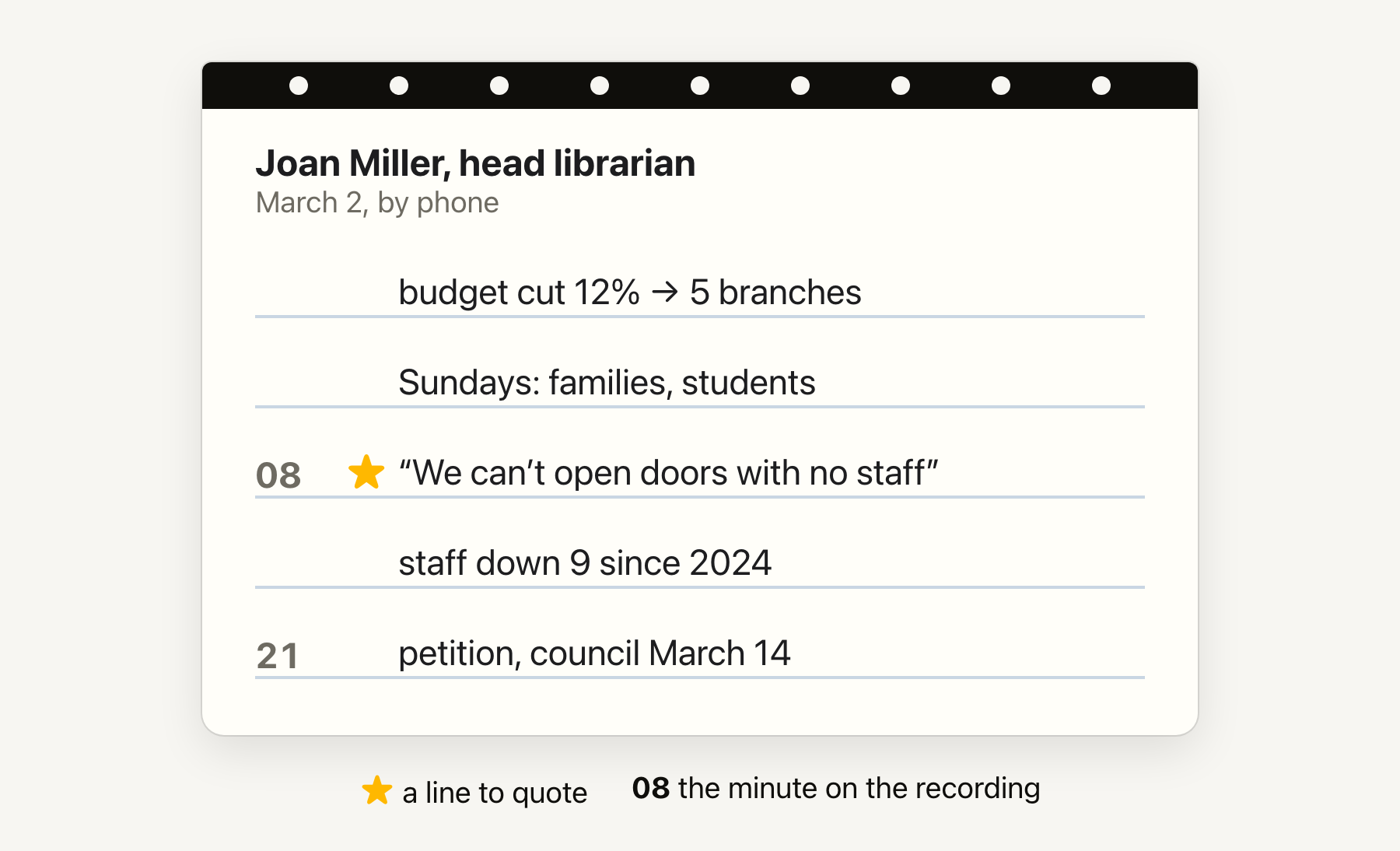
Journalists don't try to write down every word in an interview. They write down key words and short phrases, mark the lines they may quote, and record the interview as a backup. As soon as the interview ends, they fill in their notes from memory.
We have built Roar, a dictation app that is light years ahead of Apple Dictation. There's a link to try Roar for free at the end of this article.
How do journalists take notes?
Journalists write down the key words and phrases they will need for the story. This is the advice Roy Peter Clark of the Poynter Institute, a school for journalists, gives reporters. You can't write as fast as people talk, so trying to write everything means you miss most of it.
A page of interview notes can include:
- The source's name, title and the date, at the top.
- Key words and short phrases for each answer.
- Numbers, names and dates, checked with the source before the interview ends.
- A few lines written word for word, the ones you may quote.
- Marks next to the lines that matter most.
You can also use your own short forms to write faster. A reporter's tip sheet from NewsLab, for example, uses a dash for "not" and an underline for "ing" at the end of a word. Any system works if you can read it back an hour later.
How do you mark a good quote in your notes?
Put a mark next to it that you will see at a glance, like a star or an arrow. Poynter suggests marking your notes with stars, arrows or notes in the margin, like "good for the end of the story".
If you are recording, also write the minute on the recording next to the line. Then you can find the exact words later without listening to the whole interview. Our guide on how journalists transcribe interviews shows how to keep a log of those minutes and use it.
How do you get a quote word for word?
Ask the source to wait while you write it down. Poynter suggests saying something like "Please give me a second; I want to write that down." Asking them to wait also shows the source you want to get their words right.
Quotes must be exact. The Reuters Handbook of Journalism says quotes must never be changed, except to remove a word or phrase that repeats. If you are not sure of the exact words in your notes, check them against the recording. If you can't, don't use quotation marks. Say what the source said in your own words instead.
Should you record an interview?
Yes, if the source agrees and the law allows it. But don't rely on the recording alone. Poynter advises backing up a recording with notes in your notebook. A recorder can stop, a battery can run out, and a file can be lost.
Your notes also save you time. With the best lines marked and their minutes written down, you only need to listen to a few short parts of the recording.
What should you do right after an interview?
Read your notes as soon as you can, and fill them in from memory. Poynter's advice is to do this as soon as possible after the interview, because memory fades fast.
- Find a quiet place for 10 minutes, before your next call or meeting.
- Read your notes from top to bottom.
- Turn the short phrases into full sentences, while you still remember what the source meant.
- Write down what you saw, like the room, the source's mood, or a document they showed you.
- Mark anything you need to check, like a number or the spelling of a name.
You can do this step faster by saying it instead of typing it. Click into a document, press the Microphone key on your Mac, and talk through your notes. Our guide on how to dictate on a Mac shows how to turn on Apple Dictation.
Do journalists still use shorthand?
Some do. In the UK, many reporters learn Teeline, a shorthand system invented by James Hill. The National Council for the Training of Journalists (NCTJ) still teaches and examines it. Shorthand is optional for its diploma. To get the top grade, called the Gold Standard, students who take shorthand need at least 100 words per minute.
In the United States, you can use a recorder and your own short forms instead.
What is the 80/20 rule in interviewing?
The 80/20 rule says the interviewer should talk about 20% of the time, and the person being interviewed about 80%. It is common advice for job interviews. The University of Nebraska-Lincoln, for example, gives it to employers who are hiring.
The same idea helps reporters. The less you talk, the more your source says, and the more you have to quote. Ask short questions, then stop and listen.
What are the 5 R's of note taking?
The 5 R's are Record, Reduce, Recite, Reflect and Review. They come from the Cornell method of note taking, which students use in lectures.
- Record: write down the main facts and ideas as you hear them.
- Reduce: soon after, sum up each part in a few words in the margin.
- Recite: cover your notes and say the main points from the margin alone.
- Reflect: think about what the notes mean, and add your own thoughts.
- Review: read your notes again every week.
For a reporter, Record and Reduce matter most. Write key words during the interview, and sum them up as soon as it ends.
When should a journalist pay for a dictation app?
For simple, short text, like a text message, a web search or a quick reply, Apple Dictation works fine in most cases.
A paid app makes sense if you write for hours every day, and if you don't want to fix the dictation errors that Apple Dictation makes.
We've built Roar, the best way to write with your voice. Roar cleans up and formats text based on where you're writing to retain your exact meaning. Think of how emails, LinkedIn posts and AI prompts all need to be formatted differently. It keeps your exact words, to the best extent possible. Roar types into Google Docs, Gmail and Slack, so you can say your notes, a first draft or a message to your editor where you already write.
Roar keeps no recordings of your voice and no transcripts on our servers. It does not use your data to train AI models. Roar works on Macs with macOS 14 Sonoma or later and Apple silicon (M1 or newer).
Your first 5 dictations on Roar are free. You can read how Roar works for journalists or download Roar for Mac.